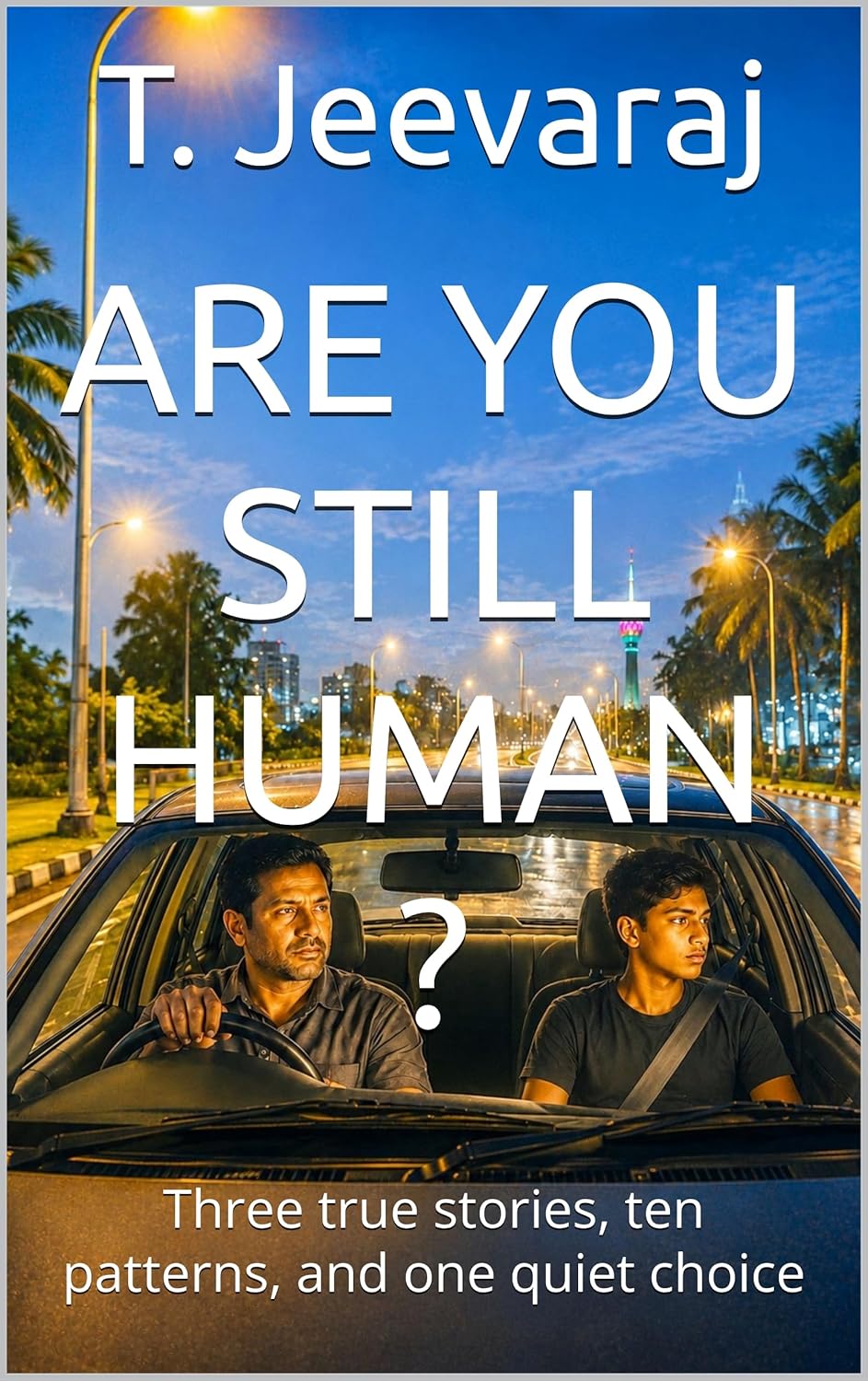
- Kindle eBook
- 37 pages
- $2.99 — Free with KU
- May 2026
- Dr. T. Jeevaraj
This is a short book about a long shift.
Not the kind that happens in a hospital ward, though those appear here too. The shift this book is about happens slowly, over years, in ordinary places: in the car on the way home from school, in a clinical consultation, in the moment after a friend appears at a gate and you begin, without knowing it, to calculate whether you have time for this.
The book begins with three true stories. A software engineer who sees an old friend and starts optimising the meeting. A father who realises, mid-conversation, that he is prompting his own son the way he prompts an AI system. A colleague who cannot locate her grief — and wonders, very quietly, whether ten years of optimising everything at work has taught her brain to pre-empt it.
These are not stories about people doing something wrong. They are stories about what happens when a particular set of habits — useful, effective, well-rewarded habits — begins to bleed into parts of life where those habits do not belong.
After the three stories, the book identifies ten patterns. Each one describes a quiet shift that artificial intelligence exposure tends to produce in human thinking: the compression of reflection, the borrowing of machine confidence, the framing of attention as a resource to be allocated rather than a presence to be given. None of these patterns is a diagnosis. They are observations — offered to the reader as something to recognise in their own life, or not.
The book does not conclude that technology is bad for human beings. It concludes something more specific: that certain tools, used for long enough, shape the mind that uses them. This has always been true. The printing press changed how people thought about memory. Clocks changed how people thought about time. The question this book asks is what the current tools are quietly changing — and whether, knowing that, you would like to choose differently in at least one place.
The book is 37 pages long. It can be read in an afternoon. It is written for people who build intelligent systems and for people who simply live alongside them — which is, increasingly, everyone.
“I had spent ten years building systems to make healthcare smarter and faster. Then I looked up and noticed what those ten years had quietly done to me — and to the people around me. There was no dramatic moment. There was just a question, arriving late.”
— Dr. T. Jeevaraj, from the introductionDr. T. Jeevaraj is a physician, health informatics researcher, and author based in Sri Lanka. He holds qualifications in MBBS, MCGP, and MSc Biomedical Informatics, and is currently an MD Trainee in Health Informatics at the Postgraduate Institute of Medicine, University of Colombo.
More about the author →The Memory Witness
A psychological novel. Alzheimer’s disease, AI memory reconstruction, and a fifty-year family secret. Set in near-future Sri Lanka.
Development journal →