
What traveled through those conversations was not only advice. It was the quiet assurance that he was not facing this alone. A memory from rural primary care in Sri Lanka
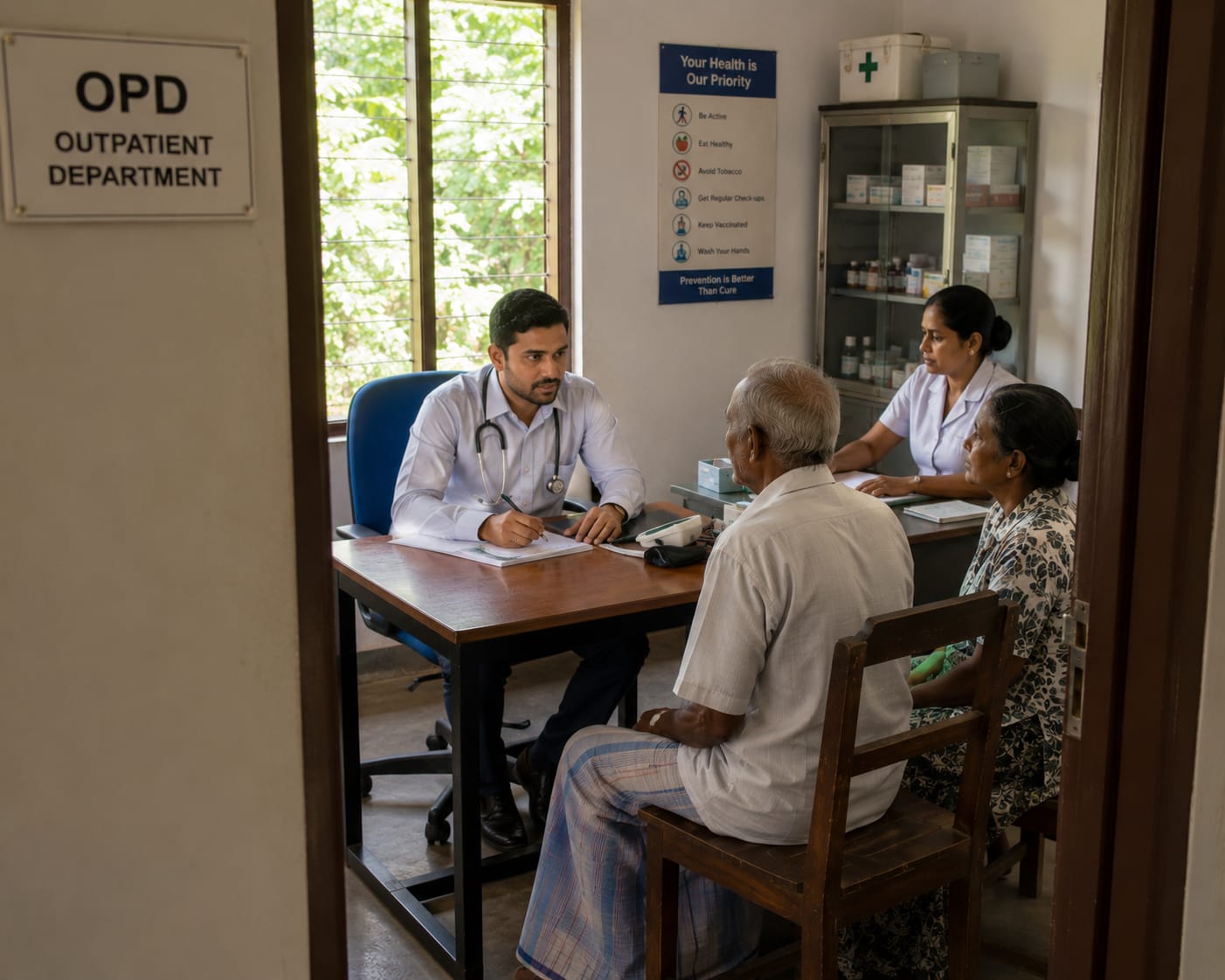
There was an elderly man I remember from my first years in rural primary care. He came to me with back pain, but he did not arrive alone. He arrived carrying conversations.
Before he described the pain, he described the people. His daughter had said rest. A neighbour had recommended a particular oil used for generations. A friend who had suffered something similar years earlier had urged him, quite firmly, not to ignore it. By the time he sat down across from me, the consultation was not the beginning of his journey. It was the final step in a long, warm chain of human contact. Several people had already thought carefully about this man's body, and every one of them had let him know it.
I did not fully appreciate what I was witnessing at the time. But I understand it now. What traveled through those conversations was not only advice. It was the quiet assurance that he was not facing this alone.
Health Advice Has Always Been a Social Act
In our communities, becoming unwell has never been a private event. People speak first with family. Then friends. Then a trusted pharmacist, a neighbour, an elder whose opinion carries weight. By the time a patient reaches the clinic, several people have already weighed in — some knowledgeable, some not, but all present. The advice that moves between them may be imperfect. Some of it is, inevitably. But something valuable has always traveled alongside it: shared attention, companionship, and the feeling of being held inside a community's concern.
In my experience of primary care in Sri Lanka, health decisions have rarely been individual ones. A family gathers. An older relative gives their view. Someone accompanies the patient to the consultation and sits beside them, ready to ask the question the patient is too frightened to ask alone. I have seen this more times than I can count. A daughter who translates not language, but emotion. A son who makes eye contact with me when his father cannot. The encounter is clinical, yes. But it is also unmistakably human, and the two have never been easy to separate.
Then Something Changed
(Clinical details have been altered to protect patient confidentiality.)
A few months ago, a patient came to my clinic. Before I could ask about their symptoms, they turned their phone screen toward me. They had described what they were feeling to a conversational AI the previous night — late, when no clinic was open and no one they knew was available to call. The system had returned a structured response: possible causes, in order of likelihood, red flags to watch for, and a clear recommendation to see a doctor.
"It helped me understand what might be happening," they said. "I came here to confirm."
I looked at what the AI had written. It was well-constructed, cautious, and largely accurate. And I felt something I could not immediately name. Not disapproval — I know better than that. Something more like absence. There had been no daughter, no neighbour, no late-night call to a cousin who had once been through something similar. The chain of people had collapsed into a single, silent screen.
Why AI Feels So Reassuring
It would be too simple to say people turn to conversational AI because they believe it is always right. In my experience, that is rarely the whole reason. When someone is frightened at two in the morning — when the chest feels tight, when the child has a fever and will not settle — what they need is not only a correct answer. What they need is someone who will respond.
Conversational AI is extraordinarily good at providing that feeling. It does not ask whether the question is silly. It does not sound tired or impatient. It never makes a person feel they are imposing. And so trust builds — not because accuracy has been verified, but because the tool has been reliably calm and kind at exactly the moment when calmness and kindness were most needed.
This matters to understand clearly, because reassurance and accuracy are not the same thing. A system that delivers one with great consistency can easily be mistaken for excelling at the other. The relief the mind feels is real. But relief is not the same as being well-informed, and feeling cared for is not the same as being cared for.
Comfort and correctness are not the same thing
Much of what patients need during illness is to feel heard and less afraid. Conversational AI is remarkably good at providing that feeling, at any hour, without judgment. The risk is not that this comfort is false — it is genuine. The risk is that comfort, delivered convincingly, can quietly substitute for the slower human conversations that once carried the same reassurance alongside real human presence.
What Is Quietly Being Lost
What those older conversations carried was not only information. It was presence. When a worried patient speaks to a family member or a trusted neighbour, something more than words moves between them. There is recognition. There is empathy shaped by shared history. There is the unspoken comfort of a familiar face and a cultural understanding that does not need to be explained.
An elderly woman talking to her neighbour about her knees receives more than advice. She receives companionship. A family gathered around a parent's new diagnosis does more than solve a practical problem. It strengthens itself in the solving. These things are difficult to measure, which is precisely why they are easy to overlook.
As conversational AI becomes the first port of call for health questions, those informal webs of support may quietly thin out. Not suddenly, and not dramatically — but steadily, interaction by interaction, query by query. A person can now hold more health information than any previous generation and yet face it more alone. And we may only notice the warmth has faded once it is already gone.
Efficiency is not the same as wellbeing. Faster answers are not the same as better care.
What This Means for Those of Us in Healthcare
For health professionals, this shift redefines our role rather than diminishing it. Patients increasingly arrive having already gathered information. They are not less informed than previous generations — in many ways they are more so. What changes is what they need from us.
I find myself spending less time explaining what a condition is and more time helping someone place what they have already read within the context of their actual life and body. The young man who came to confirm his AI's answer did not need me to describe his symptoms. He needed me to sit with him, look at him as a whole person, and help him understand what the information actually meant for him. Empathy, judgment, the particular weight of human presence during a frightening moment — these are the things that cannot be replicated, and they are exactly where our attention must now go.
There is also a dimension that concerns me at the population level. When large numbers of people consult similar AI systems, inaccuracies that are small at the individual level may scale across communities in ways that are difficult to detect or correct. When health advice flows through a handful of platforms rather than through the distributed, self-correcting networks of families and communities, questions of accountability and equity stop being individual concerns. They become structural ones.
Not Humans or AI — Humans and AI
I want to be careful here. This is not an argument against conversational AI. The same curiosity that draws me toward health informatics — toward building tools like ICD-O coding assistants for cancer registry work — makes me genuinely hopeful about what these systems can offer. For someone who is isolated, geographically or socially or economically, a well-designed AI assistant may be the most responsive and non-judgmental voice available to them. That is not a small thing.
The future I hope for is not people or AI. It is people and AI working alongside each other. A future where technology carries information efficiently and human communities continue to carry connection. Where AI accelerates the practical and human presence anchors the emotional. Where no one has to face illness alone — not merely because a machine is available at midnight, but because people still are.
Technology should strengthen human relationships, not silently replace them
AI can carry the information. People must continue to carry the connection. The measure of success is not how little we need each other. It is how much better we can care for one another when good tools and good relationships work side by side — each doing what only it can do.
A Reflection to Close
The elderly man with the back pain, who arrived at my clinic one morning carrying the advice of half his village, was participating in something that predates formal medicine by centuries. His journey to my consultation room was as much a social act as a clinical one. Those conversations had given him more than guidance. They had given him the feeling of being accompanied — of belonging to a community that noticed when he was unwell and thought carefully about how to help him.
Healthcare has never been only about data, or diagnosis, or the right prescription. It has always been, at its heart, about relationships. As remarkable new tools enter that space, the question I keep returning to is not whether AI can give good health advice. It clearly can, and often does.
The harder question is whether we can ensure that receiving health advice still feels like being cared for. That is not a technology problem. It is a human one. And it belongs to us to protect.